Showing posts with label Beguines. Show all posts

Monday, September 10, 2018

Long-Ago Christians Passionately Pursuing Christ

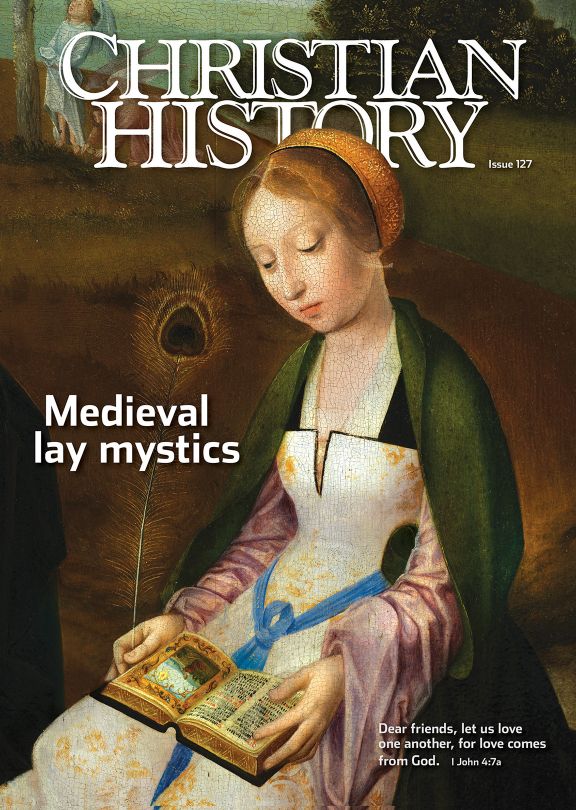
Christian History Magazine #127 - Medieval Lay Mystics

What was it like being a Christian when no one had a copy of the Bible? Well into the Middle Ages, the only copies of the Bible were in churches and monasteries. Laypeople had very little available to them before the year 1200. But from that time on, there were some great spiritual renewal across Europe.

Christian History Magazine just came out with an issue of Medieval Lay Mystics. These are laypeople who lived before 1500 who wanted to have a personal walk with the Lord. Many had a deep prayer life. Two of the items in this issue I wrote. You can copy and paste the links from here or just go to the sidebar and click!


Thursday, April 28, 2011

Beguine Classics: Mechthild of Magdeburg

O God, You are my God;
Early will I seek You;
My soul thirsts for You;
My flesh longs for You
In a dry and thirsty land
Where there is no water.
-Psalm 63:1 (NKJV)

Aching for More of the Lord
Have you ever longed for the Lord so much that you literally ache for his presence, his touch, his love? In Psalm 63 David describes such an inner craving that even his body yearned for the Lord.

This same longing is articulated by one of the godly women known as the Beguines. Mechthild joined a Beguine community in Magdeburg, Germany, in the thirteenth century and spent many years there. Mechthild was passionately in love with the Lord from the time she was twelve years old, and she pursued the Lord continually:

“O Lord, if it could ever happen to me that I might gaze upon you as my heart desires and hold you in my arms, then the divine pleasures of your love would needs permeate my soul to the degree possible for people on earth. What I would be willing to suffer thereafter has never been seen by human eyes. Indeed, a thousand deaths were too little. Such, Lord, is my painful longing for you!” (p. 134)

During the latter half of her life she wrote her work, Flowing Light of the Godhead, describing her walk with the Lord and inviting other thirsty souls to pursue God with all their heart, mind, soul and strength. Mechthild writes:

“I delight in loving him who loves me, and I long to love him to the death, boundlessly, and without ceasing. Be happy, my soul, for your Life has died for love of you. Love him so fiercely that you could die for him. Thus you burn ever more without ever being extinguished as a living flame in the vast fire of high majesty.” (p. 53)

God’s Flowing Love
As much as Mechthild enjoys the Lord’s presence, however, spiritual experience per se is not the theme of her book. Rather, she focuses on God’s overflowing love that continually pours out toward us.

The Christian life always begins with God. Our story begins with God’s initiative to love us and reveal himself to us. When we receive Christ, it is simply in response to his love for us since before the foundation of the world (Ephesians 1:4)! When we pray, we are simply articulating desires that he has placed on our hearts. God is always prior. God is always self-giving and self-revealing. God is love!

God’s unceasing river of love is what Mechthild’s book is all about:

"O you pouring God in your gift!
O you flowing God in your love!
O you burning God in your desire!
O you melting God in the union with your beloved!
O you resting God on my breasts!
Without you I cannot exist.” (p. 48)

In light of God’s overflowing presence that is available to us, Mechthild invites us as her readers to continually soak in that love and pour it out to others. Let her prayer be the prayer in each of our hearts:

“Jesus, dearest Lover of mine, let me approach you . . . with deep love for you in my heart, and never let me grow cold, so that I constantly feel your intense love in my heart and in my soul and in my five senses and in all my members. Then I can never grow cold.” (p. 309)

Mechthild’s Classic
If your heart resonates with such passionate longing for the Lord, you will want to read Mechthild’s Flowing Light. A complete edition in English is available in the Classics of Western Spirituality. All the above quotes are from this volume.

•Mechthild of Magdeburg. The Flowing Light of the Godhead. Translated by Frank Tobin. The Classics of Western Spirituality. Mahwah, NJ: Paulist Press, 1998.

My book that was just released in IVP’s Formatio Series provides an introduction to Mechthild and the key spiritual formation themes that she explores.

•Myers, Glenn. Seeking Spiritual Intimacy: Journeying Deeper with Medieval Women of Faith. Downers Grove, IL: InterVarsity Press, 2011. ISBN: 978-0-8308-3551-5.

Mechthild’s writings can be found in several other collections, including the following:

•Bowie, Fiona, ed. Beguine Spirituality: Mystical Writings of Mechthild of Magdeburg, Beatrice of Nazareth, and Hadewijch of Brabant. Spiritual Classics. New York: Crossroad, 1990. ISBN: 0-8245-0993-5.
•Murk-Jansen, Saskia. Brides in the Desert: The Spirituality of the Beguines. Traditions of Spirituality Series. Maryknoll, NY: Orbis Books, 2004. ISBN: 1-57075-201-X.

2010 © Glenn E. Myers

Tuesday, April 19, 2011

Beguine Classics: Hadewijch of Brabant

What does it mean to be in love with Christ? In concrete ways, how do we pursue him with all our heart, mind, soul and strength?

The women known as Beguines help us to flesh out the answer in our everyday life. One of their original writings that we have today is by the 13th century Belgian woman named Hadewijch. Pulsating with a palpable love for Jesus, Hadewijch’s writings draw us as readers into a fresh appreciation of—and fresh encounter with—the Lord.

Passionate Love for God
First and foremost, Hadewijch invites her readers into an intimate love relationship with God who is Love.

“O beloved, why has not Love sufficiently overwhelmed you and engulfed you in her abyss? Alas! when Love is so sweet, why do you not fall deep into her? And why do you not touch God deeply enough in the abyss of his Nature, which is so unfathomable? Sweet love, give yourself for Love’s sake fully to God in love.” (Hadewijch, 56)

This thirteenth-century Beguine from Belgium was passionately in love with God! From the time she was ten years old, she had experienced God’s remarkable touch in her life. As the leader of a Beguine community, and as a writer, she called believers to leave behind half-hearted Christianity in order to plunge into a fully engaged, fervent love relationship with the Lord.

“You should always look fixedly on your Beloved whom you desire. For he who gazes on what he desires becomes ardently enkindled, so that his heart within him begins to beat slowly because of the sweet burden of love. And through perseverance in this holy life of contemplation, wherein he continually gazes on God, he is drawn within God. Love ever makes him taste her so sweetly that he forgets everything on earth.” (Hadewijch, 88)

The sweetness of such an ardent love of the Lord will woo us away from all the false loves of the world—all the distractions and addictions that clamor for our attention. These hold no interest for us if we truly taste the overpowering presence of Jesus!

When the Feelings Fade
Second, Hadewijch prepares her readers for the time when these passionate feelings and intimate encounters with the Lord fade. The emotions of falling in love do not last forever. Initial experiences of “spiritual sweetness” give way to a more mature love.

That is okay. While we are certainly to enjoy emotional connection with the Lord when we experience it, we dare not cling to it. Feelings come and go, and we cannot gauge our spiritual growth on them. Rather, the fruit by which we are known is our growth in Christ-like character.

“Virtues and not sweetness are the proof of love, for it sometimes happens that he who loves less feels more sweetness. Love is not in each person according to what he feels, but according as he is grounded in virtue and rooted in charity (Eph. 3:17). Desire for God is sometimes sweet; nevertheless it is not wholly divine, for it wills up from the experience of the senses rather than from grace.” (Hadewijch, 66-67)


Those who try to cling to feelings and experiences are often led astray. Indeed, we find out that they were more interested in having a “spiritual high” than they were in loving God.

“For we discover in these souls that as long as sweetness endures in them, they are gentle and fruitful. But when the sweetness vanishes, their love goes too; and thus the depths of their being remain hard and unfruitful. . . . These are fainthearted folk; they are easily elated when all is sweet and distressed when anything is bitter. A small heavenly favor makes their heart exceedingly joyful, and a small sorrow exceedingly afflicts it.” (Hadewijch, 67)

Although it is hard to let go of those initial feelings of being in love, we must do so in order to move on a mature love of Christ. Hadewijch is a wise guide in this process.

Invitation to Read the Classics
Hadewijch’s writings consist primarily of poetry with some letters she wrote to younger women she mentored, as well as fourteen visions that she recorded. If you appreciate poetry and profound figurative language, you will really enjoy this Beguine’s works.

A full collection of Hadewijch’s writings in English is available in the Classics of Western Spirituality. All the above quotes are from this volume.

•Hadewijch. Hadewijch: The Complete Works. Translated by Mother Columba Hart. Mahwah, NJ: Paulist Press, 1980. ISBN: 0-8091-2297-9.

My book that was just released in IVP’s Formatio Series provides an introduction to Hadewijch and the key spiritual formation themes that she explores.

•Myers, Glenn. Seeking Spiritual Intimacy: Journeying Deeper with Medieval Women of Faith. Downers Grove, IL: InterVarsity Press, 2011. ISBN: 978-0-8308-3551-5.

Hadewijch’s writings can be found in several other collections, including the following:

•Bowie, Fiona, ed. Beguine Spirituality: Mystical Writings of Mechthild of Magdeburg, Beatrice of Nazareth, and Hadewijch of Brabant. In Spiritual Classics. New York: Crossroad, 1990. ISBN: 0-8245-0993-5.

•Dreyer, Elizabeth A. Passionate Spirituality: Hildegard of Bingen and Hadewijch of Brabant. New York: Paulist Press, 2005. ISBN: 0-8091-4304-6.

•Murk-Jansen, Saskia. Brides in the Desert: The Spirituality of the Beguines. The Traditions of Spirituality Series. Maryknoll, NY: Orbis Books, 2004. ISBN: 1-57075-201-X.

Especially if the feelings of spiritual sweetness have faded in your life and you wonder why the Lord is ignoring you, I highly suggest Hadewijch’s writing. She offers some of the deepest insights, and she expresses herself with profound thought and heartfelt passion.

2010 © Glenn E. Myers

Saturday, April 9, 2011

Seeking Spiritual Intimacy


Just a quick note this week to say that my book is out and is available on Amazon!

Saturday, August 14, 2010

Clare of Assisi and the Beguines: Solidarity with the Poor and Needy


Little- known Beguinage

Outside Assisi Italy

Now privately owned


Clare’s stay at the Benedictine convent was short—perhaps only several weeks. While she appreciated the committed life of the nuns, she wanted to follow Francis’ pattern rather than that of the Old Monasticism. Traditional monasticism in the Middle Ages maintained the class distinctions of the world. Daughters of nobility lived lives of relative leisure in the Benedictine convents. They came in with sizeable dowries from their families—along with a maid or two to wait on them—which situated them with a lifestyle they were used to. Maintaining their own room, or suite of rooms, they would never need to work a day of their lives; instead, they dedicated their time to corporate worship, study, reading and personal prayer.

It was a comfortable existence, especially pleasing to those who desired to ready and study, learn Scripture and pursue a life of contemplative prayer. However, their maids, coming from the lower classes, would spend their days cooking, cleaning and doing all the manual work for them. Likewise the convent’s fields were cultivated by the sweat of the peasants who worked the land.

No Special Privileges
Clare had problems with this inequity. Perhaps her stay at the convent of San Paolo delle Abbadesse opened her eyes to the reality of the worldly stratification that had edged into the Church because she entered not as nobility but as a commoner. Because she took vows against her parents’ desire, Clare came into the convent with no dowry. Without her inheritance to finance her stay, she was assigned to manual work with the women of lower status.

Like Francis and others in the New Monasticism, Clare envisioned a community of believers who lived life on a level playing field. She wanted to set aside the stratification of the world in order to relate to other women, sister-to-sister, instead of mistress-to-servant.

In addition, Clare disliked the total enclosure from the outside world that the Benedictine convent entailed. She wanted to be involved in hands-on ministry like Francis. Again, the movements of the New Monasticism engaged in active ministry—the evangelical life—rather than simply pulling apart from the world. While Clare deeply desired to maintain a life of prayer, she also hoped to invest her time in ministry to the poor and needy.

Beguines
Thus, after a brief abode in the convent, Clare transferred to a household of Beguines living just outside the town of Assisi. Like the Beguines of northern Europe (see Deep Wells blogs on the Beguines), these laywomen had formed their own small community where they could grow together spiritually.

In the twelfth and thirteenth centuries, “Beguine” was a generic term used for laywomen who formed their own Christian communities. Rather than a large, centralized movement, the Beguines were simply dedicated women who formed independent households all over Europe. They came mostly from the growing middle class in the emerging cities of the Later Middle Ages. Although we do not know specifics about the Beguine community where Clare stayed, most Beguines engaged in active ministry to the poor, sick and especially the lepers.

Visiting the Beguine House
The Beguine house where Clare went in 1212 still stands today just above the town of Assisi. For some years it was inhabited by Beguines and then passed into the hands of the nuns. Since around 1500, however, it has been owned privately. While much of the house has been rebuilt over the centuries, two rooms—pictured above—have the original walls intact.

On our pilgrimage to Assisi in April, we had the phenomenal opportunity of visiting the very house where Clare stayed. Bret Thoman, the leader of our pilgrimage, lived with his wife and family for some time in Assisi and discovered many out-of-the-way places like this. (See link to StFrancisPilgrimages.com.) During our visit he took our group to the house, and the family who currently own the estate graciously allowed us to tour the parts of the manor house that were original to Clare’s day.

2010 © Glenn E. Myers

Friday, March 19, 2010

Beguines: The "New Monasticism" of their Day


Beguinage
Leuven, Belgium

Presently part of the University of Leuven


In many ways the Beguines were a part of the “New Monasticism” of their day. While remaining laywomen, most of them lived together in communities. Some of these were smaller households of a dozen believers; others developed into communities of several hundred women. Early in the movement married women were among the Beguines, living with their families and joining the community of single women for Scripture reading and ministry as they were able.

The Beguines committed themselves to a simple spiritual rule of gathering for Scripture morning and evening. This was a much simpler rule than the Benedictine monks and nuns who attended chapel seven times each day. Such a simple rule allowed the Beguines to work for a living throughout the day. Especially those who spun wool and pressed linen were able to focus on the day’s reading as they worked with their hands.

They cultivated spiritual friendship within their communities, nurturing a common spiritual life. Beguines also made a commitment of obedience so long as they remained in the beguinage.

The wealthier Beguines who founded the beguinages and owned their own homes extended hospitality to needy women, inviting them to join the community. They welcomed poorer maidens from the countryside who had no money to build their own home. Such maids were provided dormitory living as minimum cost, as well as a job in the textile industry, so they could begin to earn a living.

In addition, Beguines served the general population in need—especially the poor, the sick, the lepers and the dying. They provided education for poor girls in the town who otherwise would never have the opportunity to learn to read and write.

To see the parallels with the New Monasticism movement of our day, see the website:
http://newmonasticism.org/12marks.php

2010 © Glenn E. Myers

Saturday, March 13, 2010

Beguines Model Spiritual Formation


Beguinage Brugge Belgium


The Beguines were laywomen who had a personal relationship with Jesus and formed Christian communities so that they could cultivate intimacy with the Lord. Beginning just before the year 1200, they started a movement that soon included tens of thousands of women, mostly singles and widows, who lived together in large households. Here they lived with like-minded believers and pursued knowing Jesus on a deep level. In their communities, they enjoyed a safe place to live and work, as well as fellowship with sisters in the Lord. Younger women could be mentored by older sisters in Christ, and all had the opportunity to hear Scripture read on a daily basis.

Paradigm of Spiritual Formation
The Beguines provide twenty-first century believers a wonderful paradigm of the deeper Christian life. They exemplify for us:
~Radical commitment to Christ
~Daily soaking in Scripture
~Passion for Intimacy with Jesus
~Self-sacrificing service to those in need
~Creativity—some of the first in Europe to write in vernacular
~Cultivation of genuine spiritual friendships
~Initiative in founding a new form of Christian community
Part of the radical New Monasticism of their day, they provide a working model for believers today who are sold-out for Jesus.

Monuments to the Beguine Movement
While only a few Beguines still live in Belgium today, more than a dozen of these complexes are preserved as historical sites today. The beautiful Beguinage in the city of Bruge, Belgium still stands today (photo above). Although no Beguines remain at this location, nuns now use this quiet space and wear the habits of the women who once walked here.

If you ever have the opportunity to travel to Belgium, Bruges is a must-see! It is one of the true gems of Europe. Although not as well known as some other sites on the Continent, the old city in Bruges gives you a feel for what life was like in the Middle Ages. The Beguinage welcomes tourists and pilgrims, who are invited to quietly explore the grounds and join in the chapel for evening vespers. One of be best preserved beguinages, Bruges gives Christians today a glimpse of the dedicated lives lived by these saintly women of God.

Great Books on the Beguines
Bowie, Fiona, ed. Beguine Spirituality. Crossroad, 1990.
Dickens, Andrea J. The Female Mystic. I. B. Tauris, 2009.
Grundmann, Herbert. Religious Movements of the Middle Ages. University of Notre Dame Press, 1995.
Hadewijch. Hadewijch: The Complete Works. Paulist Press, 1980.
King, Margot, trans. Two Lives of Marie d’Oignies. Peregrina Publishing, 2002.
Lerner, Robert E. The Heresy of the Free Spirit in the Later Middle Ages. University of California Press, 1972.
The Life of Beatrice of Nazareth, 1200-1268. Cistercian Publications, 1991.
McDonnell, Ernest W. The Beguines and Beghards. Rutgers University Press, 1954.
McGinn, Bernard, ed. Eckhart and the Beguine Mystics. Continuum, 1994.
Mechthild of Magdeburg. The Flowing Light of the Godhead. Paulist Press, 1998.
Murk-Jansen, Saskia. Brides in the Desert. Orbis, 2004.
Simons, Walter. Cities of Ladies. University of Pennsylvania Press, 2001.

Bowie and Murk-Jansen’s works offer nice introductions to the spirituality of the Beguines. Simons provides a readable but thorough study of the development of the Beguine movement in Belgium, highlighting its early years as well as the establishment of the great Beguine complexes/compounds, some of which stand today. Grundmann paints a broader picture of the Beguine movement, introducing readers to its development in Germany and placing it in its historical context of the great women’s revival that swept northern Europe. Although this is by no means an exhaustive list of books on the Beguines, these are some of the most helpful.

2010 © Glenn E. Myers

Tuesday, March 2, 2010

Pilgrimage to Beguine Complexes in Belgium


Leuven Beguinage


Church begun in 1234


My wife, Sharon, and I have read about the Beguines with fascination over the past eight years. In 2005 we had the opportunity to visit various Begijnhoven (beguinages) in Belgium for two weeks. What a privilege to wander the streets where these godly women once walked! Our day in Leuven still stands out to us!

At its peak, some 300 Beguines filled the townhomes of the Begijnhof in Leuven. They had their own church building that began construction in 1234. In fact, they were allowed to establish their own parish, separate from the town, and one of their priests eventually rose to the papacy.

While many of the women worked at spinning wool, dying cloth and pressing linen, some of the Beguines established schools, especially for poor girls of Leuven who otherwise would have no opportunity to learn to read and write. At one point the Leuven Beguine complex housed ten small schools for girls and had to refuse any more, so great was the desire for public education.

2010 © Glenn E. Myers

Monday, February 22, 2010

Visit the Beguine Complex in Leuven, Belgium


A Building from around the year 1200 in the Beguinage in Leuven (Louvain)


Walk the narrow cobblestone streets that wind through what was for centuries the Beguine complex in Leuven, and you will gain a glimpse from the past. Once home to three hundred women, this beguinage began as a small group of women devoted to serving the Lord by tending the sick and dying. Because hospitals were virtually nonexistent, these women established an infirmary around the year 1200. It likely functioned as a clinic and somewhat as a hospice for the dying. See photo on the blog of Feb 1, 2010, for a picture of that building that still stands today and functions as the faculty dining room for the University.

While most of the existing buildings standing today were built at a later time, three buildings date back to around 1200: the infirmary, the church and the building in the above photo.


Today the townhomes that made up the beguinage are part of the University of Leuven and serve as housing for students and faculty. However, all are requested to remain quite along these corridors—there is still something special about this space that was dedicated to seeking God!

Tourists and pilgrims are welcome to wander the streets and alleys. Walking here one wonders what life would have been like over the hundreds of years that Beguine women lived, worked and prayed within these walls!

2010 © Glenn E. Myers

Monday, February 8, 2010

Soaring and Sinking


Beguinage Antwerp Belgium


The Beguines model for us an excellent balance of solitude with the Lord and serving those in need. The two must always go hand-in-hand. Mechthild of Magdeburg describes these two dynamics of the Christian life in terms of “soaring” to God in intimacy and then “sinking” to the most humble of duties as we minister to others.

During intimate times of solitude, we soar to God in spiritual ecstasy, writes Mechthild. “Ah, kind Father, God in heaven, draw my ever-flowing soul unimpeded into yourself and flow toward [me], Lord, with all the delightful things you have within yourself. . . . Ah, and give me, Lord, the rapture of your Holy Trinity in the sweet soaring of love, Lord, so that I may enjoy with honor all your generous gifts and so that, sweet Lord, I may never ask you for something, Lord, which you do not want to give me for your glory. Amen.”(1)

Such soaring is followed by a time of “sinking down.” In service to others and in our patient endurance of suffering, we lower ourselves in humility. Soaring ecstasy and sinking humility must be kept together in the life of a believer. Indeed, the lower we are willing to sink, the more we are able to soar. As Mechthild phrases it, “The deeper I sink, the sweeter I drink.”(2)
In another passage Mechthild describes the flowing out in service and back in intimacy with the Lord by describing our soul’s climbing a mountain and descending the other side. We ascend the mountain to connect intimately with the Lord: this is our mountain-top experience of love. However, we must climb down again, bringing the power of that encounter to minister to others.

When the soul in her pursuit of love and the great longing of her God-stalking heart has ascended the lofty mountain of powerful love and beautiful knowledge, she acts like the pilgrim who has climbed the mountains with great zest. Once we have been with the Lord, we begin to cool off and sink down in profound humility, says Mechthild.

From there the soul withdraws from the intimate moment with the Lord in order to serve others for God’s glory. In fact, the soul is humbly willing to go to the lowest place possible to serve God. When the soul has therefore “ascended to those heights possible for her while she is still attached to the body and has sunk to the deepest point that she can find, then she is full gown in virtues and holiness.”(3) This is Mechthild’s ultimate concern, that through intimacy and suffering service—soaring and sinking—we would become mature in Christ-like character and holiness.
_____
1 Mechthild of Magdeburg, The Flowing Light of the Godhead, trans. Frank Tobin, in The Classics of Western Spirituality (Mahwah, NJ: Paulist, 1998), 217.
2 Ibid., 156.
3 Ibid., 184.

2010 © Glenn E. Myers

Monday, February 1, 2010

Serving Others in Need


Beguinage Kortrik Belgium


From the beginning, the Beguine movement was all about serving others in need. Many of the first informal Beguine communities in fact formed around specific ministry opportunities.

Mary of Oignies, her husband John and the women who joined them gather around the common task of tending lepers in Williambroux, not far from the town of Nivelles. This was grueling work, bandaging the festering wounds of the lepers, feeding them and praying with them as they were dying. It was also dangerous work—leprosy is highly contagious. Like Mother Teresa of the 20th century, the Beguines were willing to serve Christ in the most humbling ways.

Not far away in Leuven (Louvain), a group of devout believers also formed an infirmary or clinic for the ill around the year 1200. That original building still stands today as part of the University of Leuven. (See photo.) In time this group formed into a community of Beguines.

Beguines became known for their care of the sick and dying. In Germany, the term “Beguine” became synonymous with what we would call “hospice” work today—tending the dying, both physically and spiritually.

Beguines also became known for educating children, especially girls from poorer families who otherwise had little opportunity to learn how to read and write. Beguines not only taught them the basic language skill in the local language (Middle French, Flemish or German) but also instructed them in faith and godly character. The same beguinage in Leuven—that eventually numbered nearly 300 women—served as home to some ten small schools! In fact, they had to limit themselves to these ten schools because even more girls wanted to come for an education.

Reflection
The balance of solitude, prayer and Scripture, on the one hand, and practical service, on the other, is one of the reasons that the Beguines are so interesting—and such a good model for passionate Christians today. These women were very active in the towns in which they lived. While many enjoyed the peace and safety of living in Christian community, they did not cloister themselves away. Instead they sought to share the love of Jesus that they had experienced with all those around them, especially those in greatest need.

2010 © Glenn E. Myers

Saturday, November 14, 2009

Beguines' Love of Scripture


Museum of Beguine's Room Beguinage Brugge Belgium


I have hidden your word in my heart that I might not sin against you.(Psalm 119:11)

A Day Centered about Scripture
Each morning the women rise early and gather together to hear Scripture read. They are grateful for the opportunity to learn God’s Word. Individuals have no Bibles of their own at this time in history, but spiritual communities possess portions of Scripture that have newly been translated into Dutch, German and French. Few Beguines know Latin, so they are privileged to hear God’s Word in their native language.
After the morning chapel the women return to their rooms where they work with their hands throughout the day—sewing, spinning, and pressing linen (see above photo). All the while they repeat the morning’s passage in their minds. As they labor in silence, they meditate on the Bible reading, savoring God’s Word in their hearts. They reflect on the portion of Scripture and seek how it relates to their lives. Their whole day will focus on this passage. The opportunity to learn Scripture and soak in it throughout the day is one of the main reasons that these women joined the Beguines.

Midday they proceed to the cupboard in the corner of their room (see photo). The top third holds the dishes they brought from home, and the bottom section serves as a pantry. The middle opens into a table where they eat alone as they reflect on the day’s Scripture. Praying the passage back to the Lord, they apply it to their own life in order to be transformed by its truth.
Throughout the afternoon the women continue to work alone and then gather again in the evening for a closing chapel service for the day. Afterwards, they take time to enjoy each other’s company and share what they have learned from God’s Word throughout the day. The Beguines appreciate the fellowship they are privileged to have in Christian community.

Our Lives
Like the Beguines of long ago, let us value the tremendous opportunity we have of hearing the Bible in our own language. In appreciation, let us savor Scripture and allow it to permeate our hearts and minds throughout the day. May we soak in God’s Word, treasure our time with the Lord and be transformed by his truth and presence in our lives.

©2008 Glenn Myers
One copy of this article may be made for personal use. To receive permission for more than one copy, please contact the author.

Saturday, October 3, 2009

Love Takes Risk


Beguinage Brugge, Belgium


Although ardent desire permeates the pages of Scriptures, it often startles us when we first experience it. We are not sure what to do with such intense inner emotions. Often to experience such powerful inner longing is painful, and we are afraid of being overwhelmed.

If we are truly to experience the Lord’s love for us, we must learn to let go of control. Not only is love a powerful force, but when we are in love with God Almighty, we cannot be the ones in charge. Much of our contemporary spirituality that seeks to place God—and our relationship with him—into a neat, orderly box is merely a fantasy of our own making. Vibrant, living relationship does not fit into quick quiet times. Moreover, any “god” contained by our boxes and controlled by our expectations is not the God of Scripture who rides on the winds of the storm and in whose presence the mountains shake to their very foundation (Psalm 18).

The Beguines were not willing to settle for such tame spirituality or such a shadow of relationship with the true God. They wanted to encounter the Creator of the universe and were willing to be overwhelmed by his divine presence in prayer.

Afraid of Disappointment
Another reason we are afraid to tap into our subterranean desires is that we know we might be disappointed. Will we be hurt if we expose our hearts? What if our longing for love is not fulfilled? What if we surrender our hearts to such intense longing for Jesus only to find that we cannot truly experience an intimately relationship with him as we had hoped?

Love requires risk. When we open ourselves to be loved, it also leaves us exposed to hurt, and most of us avoid such a position of weakness. True relationship makes us vulnerable because relationships are never static. They ebb and flow, and our emotions are bound to go up and down. Even a relationship with the Lord has highs and lows as we see throughout the Psalms. The Lord never forsakes us, but at times we cannot experience him as we would like. Other times he surprises us with his manifest presence. Vital Christianity entails risk, and take that risk, we must!

Here again the Beguines provide wisdom and insight. Another of these devout women of the thirteenth century named Hadewijch wrote a letter encouraging one of the young women who looked to her as a mentor:

"O beloved, why has not Love sufficiently overwhelmed you and engulfed you in her abyss? Alas! when Love is so sweet, why do you not fall deep into her? And why do you not touch God deeply enough in the abyss of his Nature, which is so unfathomable? Sweet love, give yourself for Love’s sake full to God in love" (p. 56).

Hadewijch was aware that we can be hurt or disappointed even in our love relationship with the Lord. Because it is truly a love affair with another Person, we are vulnerable. As a result, some people who lack courage fear that cost will to too high and therefore withdraw from Love. In doing so, however, they lose all the good that they would have gained from opening their hearts to the Lord, asserted Hadewijch.

Therefore, we need to take courage: we must take the risk of opening up to the Lord. In one of her poems Hadewijch challenged us as her readers to “take the adventure”! Although our hearts might temporarily feel hurt at times, in the long run we will discover God’s great faithfulness to us. If we persevere, we will experience the fidelity of divine love.

"He who wishes thus to progress in love
Must not fear expense, or harm,
Or pain; but faithfully confront
The strictest commands of Love . . .
In all her comings and in all her goings:
Anyone who behaved thus, relying on Loves’ fidelity,
Would stand to the end, having become all love in Love" (p. 218).


Personal Reflection: Tap into Our Longing
Let us not settle for bland devotion or some tame religion. Rather, like these women of old, let our spiritual formation throb with longing for the Lord and pulsate with passion for an intimate relationship with the personal Creator of the universe. Willing to release control, let us pursue the Lord with all our heart, soul, mind and body—not satisfied with anything less than the adventure of being in love with Almighty God!

Hadewijch’s powerful writings can be found in Hadewijch: The Complete Works, translated by Mother Columba Hart, in The Classics of Western Spirituality (Mahwah, NJ: Paulist, 1980).

2009 © Glenn E. Myers

Monday, September 28, 2009

Longing for the Bridegroom

O God, you are my God,
earnestly I seek you;
my soul thirsts for you,
my body longs for you,
in a dry and weary land
where there is not water. (Psalm 63:1)

As we passionately pursue Jesus, we begin to realize how powerful a force that yearning is within us. Longing for the Lord can be intense. Throughout his life King David passionately pursued the Lord. David tells us in Psalm 63 that not only his heart, but his whole body ached for God’s presence. Likewise David compares his intense longing for the Lord to the way that a thirsty deer gasps desperately for water in the heat of the Judean desert. “As the deer pants for streams of water,” he cries out in Psalm 42, “so my soul pants for you, O God. My soul thirsts for God, for the living God. When can I go and meet with God?”

Many of the Beguines experienced the same overwhelming desire that David describes in the Psalms. These godly women in the twelfth and thirteenth centuries abandoned themselves to the Lord and longed for him with their whole heart, soul and body.

Intense Love
Because we have the writings of some of these Beguines, we can learn from their intense desire for Christ. Not satisfied with brief daily devotions, as so many Christians settle for in our day, these women sought the Lord in intense prayer. Their spiritual formation was constantly fueled by a burning love for Jesus and a yearning to draw closer to him. Mechthild of Magdeburg expressed to the Lord her inner longing:

Jesus, dearest Lover of mine, let me approach you . . . with deep love for you in my heart, and never let me grow cold, so that I constantly feel your love in my heart and in my soul and in my five senses and in all my members. Then I can never grow cold.

Like David in Psalm 63, Mechthild longed for the Lord with her whole being. Her body literally ached for the Almighty in her life and her physical senses craved his divine touch. Such a spiritual fire characterized the women of the medieval spiritual revival and can be found throughout their writings.

Mechthild’s ardent yearning for the Lord ignited a fire in her heart. Her desire for the Lord was intense and indeed all-consuming. Mechthild cried aloud in her longing for the Lord’s intimate love which is so sweet and wonderful that she said no one could begin to explain “even half of the intensity of my longing and the pain of my suffering and my heart’s pursuit and my soul’s striving for [you], to hang inseparably in your embrace forever.”

Personal Reflection
At times we all ache deeply inside. Instead of trying to ignore that ache or numb it with food, medication or busyness, we need to realize that we are ultimately craving more of God. When we do so, we can begin to allow the Lord to fill all the empty places in our hearts.

2009 © Glenn E. Myers

Monday, September 7, 2009

Passionately Pursuing Jesus

The Beguines formed communities out of a passionate desire to seek an intimate relationship with Christ. Desire is central to spiritual growth. It is our source of energy and the fire that empowers our whole pursuit of God. Our inner yearning provides direction for all that we do in life. What we desire is perhaps the most important thing about us.

In her book, Flowing Light of the Godhead, Mechthild of Magdeburg articulated this passionate desire for Jesus With a cry of her heart Mechthild expressed her longing for the Lord’s intimate love:

O Lord, if it could ever happen to me that I might gaze upon you as my heart desires and hold you in my arms, then the divine pleasures of your love would needs permeate my soul to the degree possible for people on earth. What I would be willing to suffer thereafter has never been seen by human eyes. Indeed, a thousand deaths were too little. Such, Lord, is my painful longing for you!

This burning love for the Lord characterized all of the early Beguines. They loved the Lord intensely and dedicated their whole life to desiring him. They pursued Christ by memorizing and meditating on Scripture, living a holy lifestyle, and practicing intense personal prayer that focused on an intimate relationship with Jesus. They also grew in the Lord through community fellowship and serving the needy around them.

The medieval Beguines are a wonderful model of spiritual desire for contemporary Christians. Their passion for the Lord, their pursuit of spiritual intimacy and their determination not to allow anything to distract them from that pursuit are wonderful examples for us today.

Desire for the Lord
We were designed to desire God above all else and to pursue him with our whole being. We were fashioned to love the Lord with our heart, soul and body, and to enjoy intimate fellowship with him forever. David expresses his undivided focus on the Lord in Psalm 27:4,

One thing I ask of the Lord,
this is what I seek:
that I may dwell in the house of the Lord
all the days of my life,
to gaze upon the beauty of the Lord
and to seek him in his temple. (NIV)

Personal Reflection
How can we uncover the deep yearning for the Lord inside of us? How can we nurture the same desire for Christ that we see in these women from an era long ago?

First, we need to acknowledge the distracted state of our inner lives. Taking an honest look at our disordered desires, we need to face the many things that pull on our affections and clamor for our attention. To begin the process, it is helpful to examine where our time goes. If we do this honestly, we will recognize how disordered our priorities—and disoriented our hearts—are. As we recognize our twisted wants and wishes, we can begin to surrender them to the Lord one by one. Some things we crave may be good, in and of themselves, but they must take a proper place in our lives. Others may in fact be idols that we need to discard and renounce.

Second, we must tap into the deep desires of our heart. If Christ truly lives within us, then our most profound longings are for him. Accessing our true desires, however, is often more difficult than it may sound. We will need to take time apart from all the pressures, responsibilities and people around us in order to attend to the matters of our soul. Most likely we will need to cultivate greater solitude and silence in our lives if we are to provide an environment in which our hearts will open up. If we do, we will begin to discover that the Lord truly is our genuine desire. Like the Beguines of old, we will realize how much we long for him and how much we want to grow in an intimate relationship with him.

The Beguines recognized that an intimate love relationship with the Lord is available to all believers, not just to a special few spiritual Christians. My prayer is that we would become like David in the Psalms and the Beguines of the High Middle Ages who longed for only one thing. Let us burn with desire for the Lord so that nothing else matters!

2009 © Glenn E. Myers

Monday, August 31, 2009

Seven Manners of Holy Love

Beatrice of Nazareth is often associated with the Beguines. Her mother died when she was six years old and she spend a year living with the Beguines and receiving her early education from them.

Only one section of Beatrice’s original writings have survived—a booklet on our love relationship with Jesus entitled Seven Manners of Holy Love. Here she describes seven ways we experience being in love with the Lord. Although we grow from one step to the next, we never completely leave behind our earlier expressions of love.

The first manner or mode is longing love—we simply long for the Lord and cannot get enough of him. Beatrice notes that love is the foundation of our whole relationship with God, not fear. When we truly love the Lord, we find it easy to give up shallow worldly pleasures in order to have him.

The second expression of love is service. Because we truly love the Lord, we want to do anything we can for him. Although we still long to experience his sweet presence, we shift our focus from ourselves to Jesus. If we are maturing as believers, we concentrate less own feelings and more on how we can serve the One we love.

Try as we might, however, we can never serve Christ enough. Thus, the third experience of love is one of frustration. We do all the ministry we can, but we never feel like we have done enough. Indeed, as Beatrice notes, we never will be able to fully express our gratitude for our salvation—so we feel tormented inside.

Eventually that frustration gives way to a fresh experience of Jesus’ love for us. Thus, the forth mode is overwhelming love. This is a wonderful season of life! We feel ourselves wrapped in our Savior’s arms and loved by him.

We can never seem to get enough of that love, however, and eventually we enter into frenzied love . Here we crave more and more encounters with the Lord, says Beatrice. We are overpowered by our passionate desire for the Lord, and sometimes we feel like we are going crazy.

In time our frenzy gives way to the deep, new settled love of Beatrice’s sixth mode: bridal intimacy. This profound love is what we have been hoping for in our whole relationship with Jesus. As the New Testament describes Christ as the Bridegroom and the church as his bride, we experience this on a personal level.

In this lifetime, however, we will never experience the fullness that awaits us. Thus, mode seven is a return to the longing love. Our relationship begins with desire and will continue with desire, so long as we are on this earth. That longing is good, though, because it keeps us growing deeper and deeper in our love for the Lord.

Personal Reflection
Just as human relationships go through stages—described in many books in our day—so our relationship with Jesus follows a similar path. Indeed, if our relationship with the Lord is truly personal, it will of necessity bear some of the same dynamics as our closest human relationships.

Beatrice’s analysis of our love relationship with Christ is insightful. Most readers identify with several, if not most, of her stages. While we may not all experience the same intensity as Beatrice describes, many readers have found comfort, reassurance and fresh hope from Beatrice’s wisdom.

To learn more about Beatrice and to read her original work, see The Life of Beatrice of Nazareth, 1200-1268, translated by Roger DeGanck (Kalamazoo, MI: Cistercian Publications, 1991).


2009 © Glenn E. Myers

Tuesday, August 25, 2009

Beguines: Forming Christian Communities

Across Belgium, the Netherlands, Germany and northern France, laywomen came into a personal relationship with Jesus during the late Middle Ages. In order to grow spiritually, they formed households where they could have fellowship with likeminded sisters in Christ. At first the Beguines purchased large houses where half a dozen or a dozen women could live together as a spiritual community. Just after the year 1230, however, Countess Johanna of Flanders, and other nobility made sizeable donations of land and money, allowing the women to establish large Beguine complexes. The Beguine movement exploded.

Known as beguinages, in French, and Begijnhoven, in Dutch, these communities consisted of scores of quaint townhomes built around an open square the size of several football fields placed side-by-side. The open space provided gardens for the women and, in due time, also housed a church building for the Beguines. To provide safety for all the women, a large wall surrounded the entire complex.

In Belgium alone, ten thousand women joined Beguine complexes in the next half century! Most beguinages held several hundred women, but three of them grew to enormous size: Ghent housed 700 Beguines, Liège 1000, and Mechelen eventually holding some 1900 Beguines!

While only a few Beguines still live in Belgium today, more than a dozen of these complexes are preserved as historical sites today.

Personal Reflection
These medieval women were remarkable in their initiative to form Christian households. Forming such lay communities was virtually unheard of in their day, but that did not keep the Beguines from starting something new. They were determined to have fellowship with likeminded believers and in doing so started a whole movement that lasted strong into the nineteenth century.

We today need to have that same determination in establishing spiritual friendships that will help us grow. It might be meeting with another person one-one-one each week, or it might entail beginning a small group. For some, it could be the establishment of a full-blown community like the Beguines.

An excellent book describing the Beguine movement in Belgium is Walter Simons, Cities of Ladies: Beguine Communities in the Medieval Low Countries, 1200 – 1565 (Philadelphia, PA: University of Pennsylvania Press, 2001).


2009 © Glenn E. Myers

Monday, August 24, 2009

Beguines Tending those in Need

The sun shines on the Belgian countryside as Mary recites her vows to the young man named John. Mary comes from a well-to-do family in the town of Nivelles, and, as most marriages in her day, Mary’s has been arranged by her parents. The year is 1190, and Mary is fourteen years old.

Because John’s family is also wealthy, the couple lives comfortably, and the first several years of their life together are unremarkable. All of this changes dramatically, however, when Mary makes a radical response to the gospel. Unwilling to settle for the complacent Christianity of her day, she recognizes the need for a personal response to Jesus’ invitation. Upon committing her life wholeheartedly to God’s service, Mary convinces John to join her in the venture and they give all of their possessions to the poor. They take an extraordinary step of faith as they lay aside their life of privilege to pursue a life of prayer and service to others. Rather than moving apart from each other to enter separate convents, as is the custom for godly couples in the Middle Ages, Mary and John remain together and devote themselves to seeking the Lord and serving the infirm.

They move some thirty miles to the town of Williambroux and consecrate the next fifteen years to serve a group of lepers. Their days revolve around the tasks of feeding and washing the ill. The stench of decaying flesh fills John and Mary’s nostrils as they bandage open sores. Far from the affluence they have known, their lives center about menial chores and the constant danger of contracting leprosy, yet the couple is content to serve Christ by salving the neediest of the needy.

Because John and Mary give away their inheritance to provide for the poor and sick, they assume the task of supporting themselves while they serve the infirm. They subsist on the meager wages they can earn working with their hands. After a day attending to lepers, Mary often stays up half the night to spin and sew, making enough income to provide them with the basic necessities of food and clothes. In addition she goes door-to-door raising funds for their ministry, seeking donations from middleclass and affluent people in town, suffering the humiliation of being called a beggar.


News travels throughout the region of Mary’s commitment to Christ, her deep Christian walk, and her passion to grow in the Lord. As word spreads, women begin to migrate to the leper hospital to join the work and to be mentored by Mary. In addition to caring for the physical needs of the lepers, she provides spiritually for those who joined her group. Proving to be a wonderful spiritual director, Mary often receives words from the Lord for those who seek counsel from her, and her sanctified life serves as a model for all to see.

Mary’s group develops into one of the first Beguine centers in Belgium. Several other towns in Belgium also see groups form, often around a lead figure like Mary. One of these groups forms in the nearby town of Leuven as women establish an infirmary for those who are ill. Hospitals are virtually nonexistent at this time, so tending the sick is left into the hands of well-meaning Christians who dedicate their lives to serving others.

Today much of the Beguine complex in Leuven still stands as part of the university there. The original infirmary/hospital from the early 1200 serves as the faculty dining hall!

Personal Reflection
One of the things that impresses me most about the Beguines is that they kept personal spiritual growth together with service to others. So often we choose one or the other. Either we pull apart for deep personal growth or we become so active serving others that we neglect our inner spiritual life. The Beguines in general, and Mary of Oignies in particular, kept love of God and love of neighbor together in a beautiful way. They serve as wonderful examples to the to twenty-first century church!

You can read about Mary, her profound commitment to service and her deep prayer life in James of Vitry, The Life of Mary of Oignies, in Two Lives of Marie d’Oignies, translated by Margot King (Toronto, Ontario: Peregrina Publishing, 2002).


2009 © Glenn E. Myers

Sunday, August 23, 2009

Believers Called Beguines

The setting is twelfth- and thirteenth-century Europe. It is the era of chivalry, and tens of thousands of men have gone on the Crusades. Although everyone in Christendom is part of the church, medieval Europe has been spiritually dry for hundreds of years.

In this state of affairs, the first flames of revival spread as itinerant preachers proclaim the gospel and call nominal Christians into a personal relationship with Christ. The spiritual climate changes rapidly as hundreds and then thousands of laypeople repented of a worldly lifestyle and committed themselves to Jesus.

In order to grow, many of these vibrant believers form new Christian communities to cultivate their faith and provide meaningful spiritual fellowship. After coming to Christ they are profoundly in love with Jesus, and they long to know him better. Thirsty for more than church membership or religious ceremony, they seek to nurture intimacy with the Lord by living with likeminded followers of Christ.

In particular, middleclass women across Belgium, the Netherlands, northern France and Germany pool their resources to buy houses where they can live in community. Known as Beguines, these laywomen pulsate with spiritual vitality in their pursuit of inner growth. The households they establish provide these women with friendships and a safe place to live and work.

In addition, they form communities to learn God’s Word. When the Beguine Movement begins, few resources are available for spiritual formation outside of such a community. Only portions of the Bible are accessible in the local language (for them, medieval Dutch and German); families and individuals seldom own a copy. Local priests give few sermons and are often known for their immorality rather than a life of godliness. Devotional materials are nonexistent except in Latin—in fact, some of the very first writings in German and Dutch are spiritual formation manuals written by the Beguines. Therefore, these godly women gather each morning and evening to hear Scripture read. The Beguines then meditate on passages throughout the day as they work at sewing and spinning.
One of the early Beguines, Mechthild of Magdeburg, expresses her deep, personal love for Jesus, “I delight in loving him who loves me, and I long to love him to the death, boundlessly, and without ceasing.” Mechthild then exhorted us, the readers, to pursue the Lord in the same way: “Love him so fiercely that you could die for him. Thus you burn ever more without ever being extinguished as a living flame in the vast fire of high majesty.”
[1]

That is the invitation of the Beguines—to love Jesus so fiercely that we are on fire for him and that we would be willing to die for him. These women were radical believers in their day, and they summon us to genuine faith and deep communion with the Lord today.

Personal Reflection
As an evangelical, reading about the Beguines is so interesting and so encouraging. We are not the first Christians to emphasize conversion and to nurture a personal relationship with Jesus. These women were so radical in their commitment to Christ and their cultivation of an intimate relationship with him!

For further reading about Mechthild’s deep desire for the Lord, see Mechthild of Magdeburg, The Flowing Light of the Godhead, translated by Frank Tobin, in The Classics of Western Spirituality (Mahwah, NJ: Paulist, 1998), 134.


[1] Mechthild of Magdeburg, The Flowing Light of the Godhead, trans. Frank Tobin, in The Classics of Western Spirituality (Mahwah, NJ: Paulist, 1998), 53.


2009 © Glenn E. Myers