Saturday, December 15, 2018
Third Sunday of Advent—Gaudete Sunday—Hope and Rejoicing!
“Every good thing given and every perfect gift
is from above, coming down from the Father of lights, with whom there is no
variation or shifting shadow.”
-James
1:17 (NASB)
Crisp,
clear—the sun crests over the eastern horizon this frosty morning, its rays
glistening on the snow-graced earth. The sun brings a song of rejoicing to my
heart. Its light reflects the Father of lights, in whom there is no turning or
shadow. It gives us hope of longer days, stronger sunshine and, in time, warmer
weather now not far away.
We
are in mid-December as we approach this, the third Sunday of Advent. For
centuries the church has call this Gaudete Sunday—Rejoice Sunday! On the advent
wreath we have a special rose-colored candle to symbolize our jubilation.
We
rejoice as we look forward to the celebration of Christmas, our Savior’s birth,
just more than a week away now. Just as the sun is rising this morning with
light and warmth and hope in its rays, Jesus arises afresh in our lives with
healing in his wings:
"But for you who fear my name, the Sun of
Righteousness will rise with healing in his wings. And you will go free,
leaping with joy like calves let out to pasture.” (Malachi 4:2, NLT)
At
any point in life we have sorrows and joys, some situations going well and
others seeking to overwhelm us. Whatever our circumstances right now, we can
rejoice. Our God is Light and in him is no darkness (1 John 1:5). Even if the
sunshine is not shining for us any given day, there is a cause to rejoice. Just
as the Sun of Righteousness rose in history some two thousand years ago, he
will rise afresh in our given life situation. We have hope.
This
is Advent Hope and Advent Rejoicing! This is what Gaudete Sunday is all about!
© 2018
Glenn E. Myers
Friday, December 7, 2018
Advent: Tutoring Us in the Art of Waiting
Advent
tutors us in the art and virtue of waiting. Waiting does not come easily to any
of us. Especially during the holiday season, any idea of waiting is discarded. Stores
pipe in Christmas carols from Thanksgiving Day (or earlier) to Christmas, to
put shoppers in the mood to buy. Marketers do not want anyone to hesitate but
rather to buy on impulse.
In
direct opposition to this atmosphere of having it all—and having it right
now—spiritual growth comes slowly. Our faith is built through the gradual
year-in and year-out walking faithfully with our God and being faithful to him
during exciting times and difficult times alike.
Indeed
the Greek word for faith, pistos,
means both faith (believing and trusting) and faithfulness (remaining constant
and true). We often see these as two separate ideas. However, in the Christian
life they are inextricably linked. To believe in Christ is to entrust one’s
life to him as Lord and to walk faithfully with him, hand-in-hand, during good
times and bad.
Sometimes
we experience growth spurts or seasons when we sense God’s presence so close.
However, in between times of marked spiritual growth or mountain top
experiences, “faith can demand long, patient waiting, when nothing seems to be
happening, and this is just as necessary to growth,” writes Maria Boulding.
Recently I read this quote and realized how true it is! Often our deepest
growth takes place during those long times of just being faithful in the
mundane things of life.
Maria
Boulding then ties this idea of faithfulness with Advent. “We sometimes have to
go on doing the small, ordinary things while we wait for God, as Mary did while
she waited for the birth of Jesus; we have to wait for his moment, and wait for
his work to ripen in ourselves. It may sometimes be more fruitful in the end if
we live with a lingering question, and grow slowly towards wisdom, than if we
find a quick answer partly dictated by our own desires. The waiting changes us,
schools us, teaches us to know God.”
Advent
this year—and life in general—is teaching me to wait. I want to love the
questions in my life right now. As I linger with those questions and remain
faithful in all the little responsibilities of life, God will bring about the
growth and the end results that he desires. Let me not try to prematurely
answer the questions only to end up simply following my own will. Rather, let
me like Mary, respond to the Lord: Here I am, your servant, let it be done to
me according to your word (Luke 1:38).
Maria
Boulding, The Coming of God
(Conception, MO: The Printery House, Conception Abbey, Inc., 2000), 40-41.
© 2018
Glenn E. Myers
Monday, December 3, 2018
Advent: An Invitation to Stillness
The Lord is my shepherd; I shall not want.
He makes me lie down in green pastures.
He leads me beside still waters.
He restores my soul.”
He leads me beside still waters.
He restores my soul.”
-Psalm
23:2-3 (ESV)
Advent
invites us into stillness. Away from the multiplicity of demands, opportunities
and people, our mind begins to slow down. Many, if not most, of those
opportunities and relationships that we set aside for a time are good: we were
created to live full lives in this world. However, if they are only one side of
the rhythmic pendulum of a whole, healthy life. One side swings into the
many-faceted activity and interaction of the day. Then it swings back into solitude,
silence and stillness—the time necessary to be alone with self and God. Just as
day and night alternate, so we are created to flow out and back: flowing out to
the manifold interactions of the world and then back into stillness.
The
whole of contemporary society militates against such a practice of stillness
and simplicity. Constantly multitasking, we try to squeeze more and more into
the hours of the day. Employers want greater productivity out of us.
Organizations and churches offer programs and activities to keep us occupied.
Sports and media present unending opportunities to be entertained. Advertisers
promise us greater gratification in life if we but buy more of their products.
While none of these may be innately evil, as a whole the world system distracts
us and allures us with a false assurance of genuine purpose and fulfillment in
life.
Into
such frantic busyness and multiplicity our Shepherd bids us follow him to green
pastures where we can lie down and rest. The gentle waters of a stream welcome
us to come and be restored—body, soul and spirit. A large shade tree welcomes
us to stop running long enough to enjoy the Creator’s blessings freely offered
to us. The song of a nearby bird extends an invitation to retreat from the
fragmentation of our busy world for a while and step into simplicity.
Stillness
does not come spontaneously to the human heart. Since the Fall in Genesis 3, we
are worried and anxious about so many things. Jesus points us to nature to gain
a different picture of what life could be like. “Look at the birds of the air,”
instructs Jesus; “they do not sow or reap or store away in barns, and yet your
heavenly Father feeds them. Are you not much more valuable than they? Can
any one of you by worrying add a single hour to your life?” (Matthew 6:26-27).
Stillness
must be cultivated. The more often we practice stillness, the more we are able
to carry it with us throughout the day. Even when things get hectic, we are
able to access that still place within and find peace.
Advent
is a season to cultivate such stillness. Whether it be a devotional time each
evening of the four Advent Sundays or a day’s retreat, we are invited to still
ourselves and prepare our hearts for Christ’s fresh coming into our lives.
© 2018
Glenn E. Myers
Sunday, November 11, 2018
Stillness Awaits
“Be still—let go, cease striving—
and know that I am God.”
-Psalm 46:10 (NASB and
margin note)
Divine
stillness waits for us. It beckons us to come. From a distance it welcomes our
weary heart and mind to receive rest. How often we hear that invitation, and we
desire to come. But, before we do so, we want to finish one more project. As
soon as our responsibilities are fulfilled, we tell ourselves, we will take
time to be still.
Of
course once one obligation is met or one problem is solved, two more raise
their heads, and we never quite get to that much-needed pause. That place of
stillness eludes us. Like Martha in the Gospels, we are concerned about so many
things—too anxious to join Mary in Jesus’ presence.
“Come
to me,” says our Lord. “Come to me, all you who are weary and burdened,
and I will give you rest. Take my yoke upon you and learn from me, for I
am gentle and humble in heart, and you will find rest for your souls” (Matthew
11:28-29). Jesus continues to extend the offer of inner rest. We somehow think
that we cannot come to him until we have first unloaded our own burdens.
However, it is precisely while those burdens weigh on us that we need to come.
Entering
the place of stillness necessitates that we pause from our frenetic activity,
even for five or ten minutes. Often we are afraid to do so. We are fearful of
releasing our grip.
If
we relinquish those fears and concerns to our loving God, however, we can find
rest for our souls. Such a pause can make the difference for our whole day. Our
hearts are renewed, our souls refreshed. The whole momentum of our day becomes
refocused, and we reenter our responsibilities on the right foot.
Stillness
awaits. I don’t want to ignore the Good Shepherd’s invitation.
©
2018 Glenn E. Myers
Monday, September 10, 2018
Long-Ago Christians Passionately Pursuing Christ

What was
it like being a Christian when no one had a copy of the Bible? Well into the
Middle Ages, the only copies of the Bible were in churches and monasteries.
Laypeople had very little available to them before the year 1200. But from that
time on, there were some great spiritual renewal across Europe.
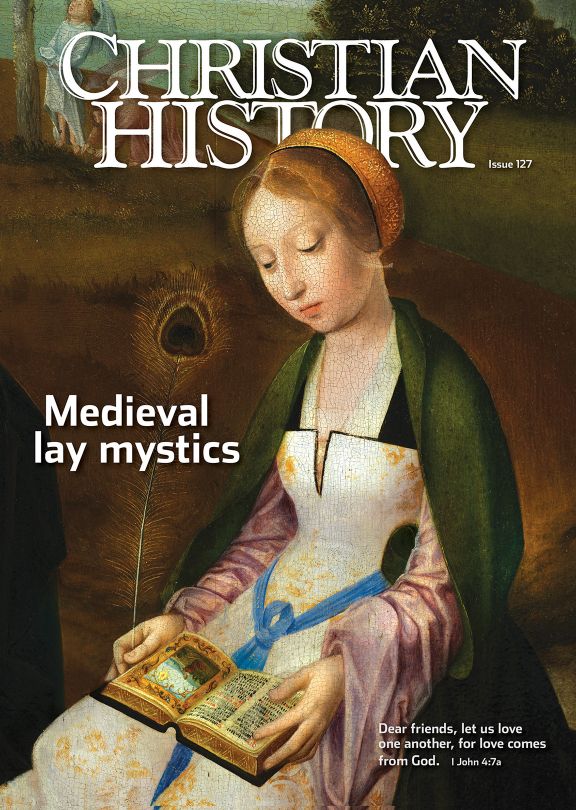
Christian
History Magazine just came out with an issue of Medieval Lay Mystics. These are
laypeople who lived before 1500 who wanted to have a personal walk with the
Lord. Many had a deep prayer life. Two of the items in this issue I wrote. You
can copy and paste the links from here or just go to the sidebar and click!
Saturday, March 3, 2018
Lent: Fasting to Confront our Destructive Passions
“Therefore consider the members of your earthly body as dead to immorality, impurity, passion, evil desire, and greed, which amounts to idolatry.” -Colossians 3:5 (NASB)
The
Apostle Paul calls us to consider ourselves dead our passions. Passions are
things that drive us, that cause us to suffer (the basic meaning of “passion”).
In our day we often employ the term “passion” in a positive sense—a passion for
reaching the hungry, a passion for Jesus. These are the things that motivate our
lives and drive us to seek and serve and the Lord.
At
the time of the writing of the New Testament and the early centuries of the
Church, however, “passion” referred primarily to the negative things that drive
us. These are the destructive compulsions and addictions of our lives. The
early theologian, Evagrius Ponticus, highlighted eight of these compulsions
that can take control of our lives: gluttony, lust, greed, anger, inordinate
sadness, bored laziness, vanity and pride.
The
practices of fasting, giving alms, and prayer confront these destructive
passions in our lives. Fasting, in particular, confronts gluttony, lust and
greed.
First
on the list of destructive passions is gluttony. When gluttony has a hold on
us, we eat not just what we need or should properly enjoy in life. Instead, we
keep on eating, trying to get more and more pleasure or attempting to fill an
empty place in our hearts. Ironically, when we are driven by gluttony, we often
eat so quickly that we fail to savor the food in our mouths. Instead, our focus
is on “getting more.”
Because
eating is essential to life, gaining self-control over the passion of gluttony
is foundational to gaining victory over all the destructive passions that seek
to control us, asserts Evagrius.
Along
with gluttony, lust is a powerful passion in our lives. Both of these are
compulsions of desire—we want something, not only to satisfy our physical needs
but to try to satisfy an inner compulsion that craves for more and more. Gluttony
and lust go hand-in-hand.
Greed
is a third passion of desire—concupiscence. God created us to desire, for
desire is what draws us out of ourselves to reach out in love toward our
Creator and other people. Because of the Fall, however, our desiring faculty (concupiscentia in Latin) has become twisted
in on ourselves. Our desiring becomes self-focused and is never satisfied. Our
gluttony, lust and greed spring from our inner concupiscence that craves incessantly.
Like an addiction, no matter how much we feed it, we grasp for more in order to
get our “fix.”
If
we can gain victory over food—a basic need of life—we can become free from lust
and greed and the underlying bottomless craving of the passions and their
demands. Fasting is therefore so important in our lives. It is not that we
ourselves gain victory by our will power. Rather, fasting exposes the inner
passions. Foregoing food brings the concupiscence to the surface where it can
be dealt with. Then we call upon God’s mercy.
Lent
is all about acknowledging our fallen nature and crying out for God’s mercy. We
can never defeat gluttony, lust and greed by fasting alone. Instead, Lenten
fasting helps us face those driving compulsions—those controlling passions—that
must be taken to the cross. As they die with Christ on the cross (Romans
6:1-14), we are raised to new life and the Holy Spirit bears the fruit of
self-control in us (Galatians 5:1-23). This is the Paschal Mystery of new life.
May
we 0pen ourselves anew this Lent to the practice of fasting so that our hidden
passions may be exposed and brought to Christ’s passion on the cross. May we
than rise with Christ to a transformed life, no longer controlled by inner
compulsions but instead free to enjoy God’s blessings, such as food, and free
to live our lives fully for our Lord!
©
2018 Glenn E. Myers
Thursday, February 8, 2018
Lent: Ash Wednesday as a Call to Return to the Lord with All our Heart
Return to me with your whole heart,with fasting and weeping and mourning. –Joel
2:12
You will seek me and find me when you seek me with all your heart. -Jeremiah
29:13
Traveling
through the daily challenges of life, we readily become preoccupied and
distracted. Our spiritual focus is easy to lose, especially because we cannot
see it with our physical eyes, while everything around us, calling for our
attention, is so tangible. Taking our eyes off the goal, we often
drift—sometimes just a little, other times quite far—from the path of pursuing
the Lord.
God’s
words through the Prophet Joel come crashing into our lives as we begin Lent:
“Return to me with your whole heart!” Ash Wednesday is a call to conversion.
All we like sheep have gone astray, as Isaiah 53:6 reminds us. So, as we begin
Lent, we must ask ourselves: Where have I wandered from the Lord? Have I
dwindled in prayer? How have I ceased loving others as I should? Has my focus
shifted from Jesus to myself?
Wherever
we have gone astray, we need to return to God with all our heart. Sorrowful for
our erring ways, we are called to return with fasting and weeping and mourning.
These three activities go together throughout the Old Testament. When the
nation of Israel mourned for their sin, it virtually always included fasting to
demonstrate their sorrow. These activities flesh out what it means to repent—to
turn around and return to the Lord.
However,
fasting, weeping and mourning are very counter-cultural. Contemporary society
says: “Eat, drink and be merry! If it feels good, do it!” Lent, to the
contrary, says: “Fast, if you are serious about seeking God. Give up what feels
good and tastes good.” Today’s world promotes a “Life’s good!” approach to
everything: “Let’s be entertained; let’s be happy all the time.” Lent, however,
reminds us that there is a time to mourn—to actively be sorry for our sin. As
Jesus said: Blessed are those who mourn, for they are the ones who will be
comforted (Matthew 5:4).
As
we enter Lent this year, let us embrace the three spiritual rhythms that
Christians have practiced since the early centuries of the Church.
First,
let us fast because fasting allows us to focus and sets us free from the
physical desires and temporal things that tend to control us. Second, let us
pray with a renewed intensity and commitment. In particular, let us seek God
afresh in prayer and wait expectantly on God to move in our lives. Third, let
us give to others. Giving alms, as it has traditionally been titled, gets the
focus off of self and gives us opportunity to become “cheerful givers.”
Returning
to God with our whole heart is what Lent is all about. Too often we simply make
superficial change and so-called conversion that is only skin deep. When,
however, we are serious enough to fast and weep and mourn, we have begun truly to
seek God. When we do that, God promises in Jeremiah 29 that we will indeed find
him: “You will seek me and find me, when you seek me with all your heart.”
©
2018 Glenn E. Myers
Subscribe to:
Posts (Atom)